April 2026 OT/ICS Cybersecurity: The Illusion of Control Is Breaking
April 2026 OT/ICS Cybersecurity: The Illusion of Control Is Breaking
A Comprehensive Analysis of Critical Infrastructure Threats and Incidents
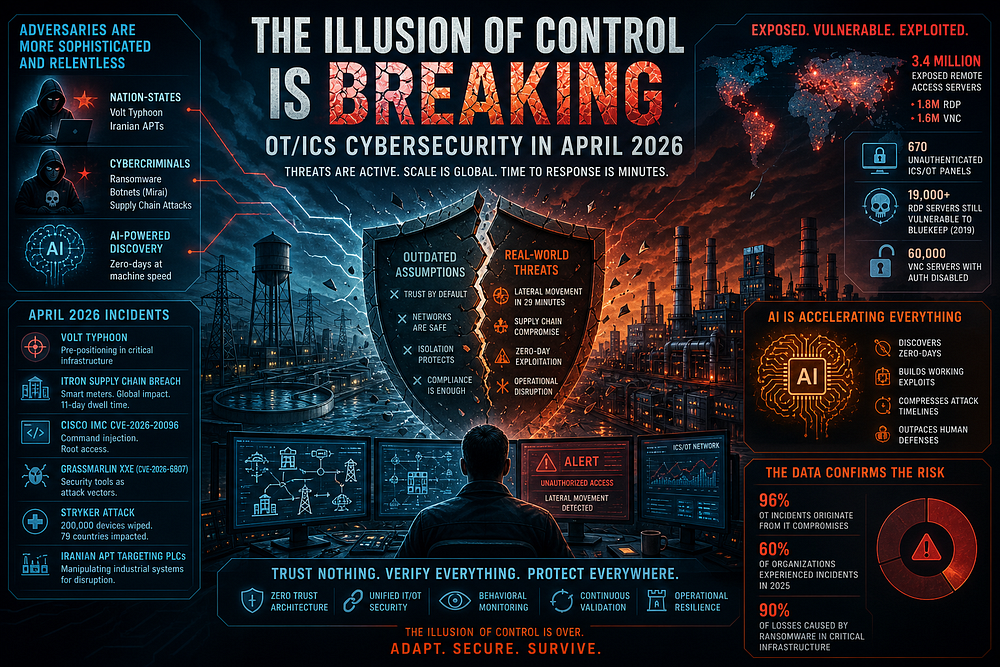
April 2026 Exposed the Truth
April 2026 didn’t introduce new problems in OT cybersecurity; it exposed how unprepared most organizations still are. Across government advisories, corporate disclosures, security incidents, and emerging research, one pattern kept repeating: organizations continue relying on outdated assumptions in systems that are now actively targeted by nation-states, cybercriminals, and increasingly, AI-driven discovery mechanisms.
This is no longer a slow-burning risk managed by compliance teams. It’s active, scaled, and accelerating. The incidents and vulnerabilities disclosed in April 2026 paint a consistent picture of organizations that are fundamentally misaligned with the threat landscape they now face.
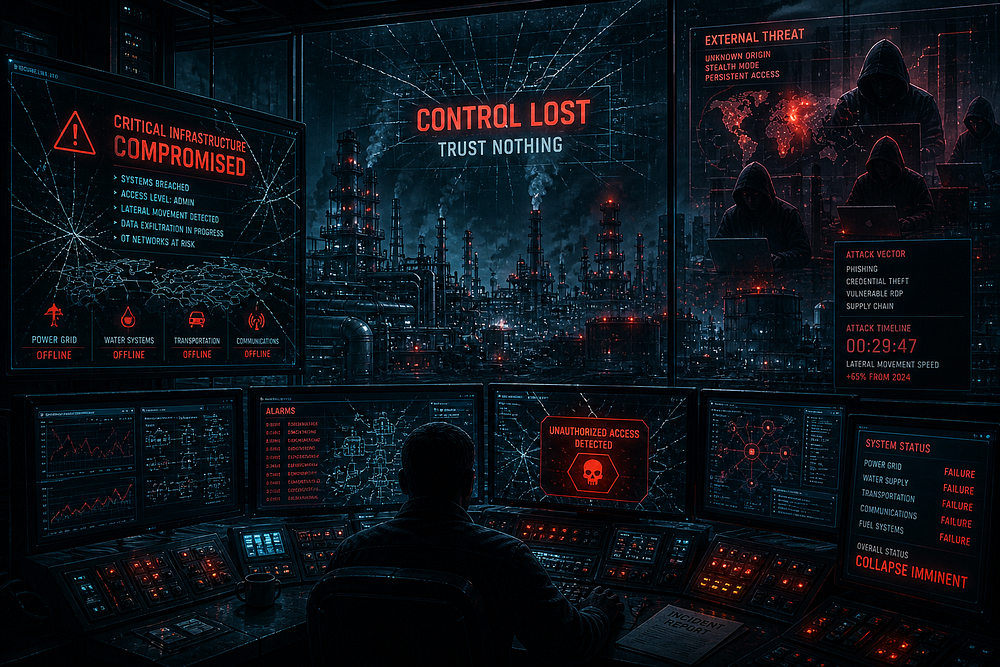
Let’s examine the major incidents and what they tell us about the state of critical infrastructure security.
Zero Trust Is No Longer Optional: Volt Typhoon and State-Sponsored Threats
The emergence of Volt Typhoon as a Chinese state-backed threat actor forced a critical shift in how U.S. agencies approach operational technology security. Joint guidance from U.S. agencies, CISA, NSA, and FBI, officially moved Zero Trust from a theoretical framework to an operational imperative for critical infrastructure.
Who Is Volt Typhoon?
Volt Typhoon (also known as Bronze Silhouette, Vanguard Panda, and Insidious Taurus) is a People’s Republic of China state-sponsored advanced persistent threat likely affiliated with the PLC’s People’s Liberation Army or Ministry of State Security. The group was publicly identified by Microsoft in May 2023, but evidence suggests activity dating back to at least mid-2021.
What makes Volt Typhoon particularly dangerous is its explicit focus on pre-positioning for operational disruption rather than traditional espionage. The group has targeted critical infrastructure across multiple U.S. sectors:
• Communications networks
• Energy sector (electric utilities)
• Transportation systems
• Water and wastewater systems
Volt Typhoon’s Attack Pattern
What distinguishes Volt Typhoon from other threat actors is its sophisticated, patient approach:
• Extensive pre-compromise reconnaissance, learning about target networks, security measures, and typical user behaviors
• Exploitation of unpatched public-facing devices (firewalls, routers, VPNs)
• Credential harvesting and lateral movement using valid administrator accounts
• “Living off the land” techniques — using native operating system tools (PowerShell, legitimate utilities) to minimize detection
- Persistence across network boundaries, maintaining access for years in some cases
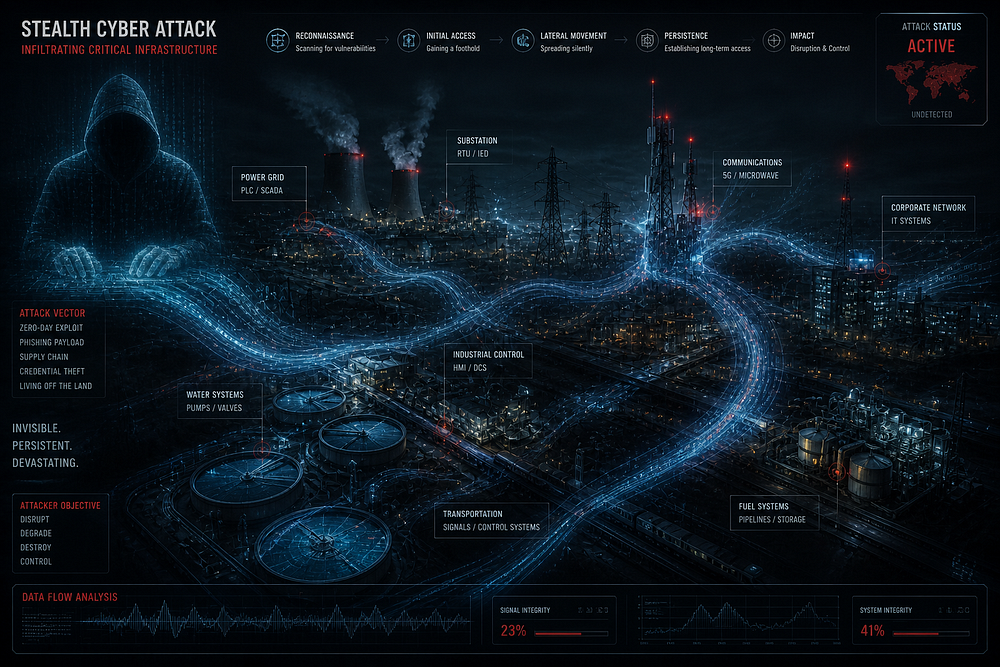
U.S. government officials assessed with high confidence that Volt Typhoon actors are pre-positioning themselves on IT networks to enable lateral movement to OT assets to disrupt critical functions. They maintain these footholds for years, waiting for geopolitical tensions or military conflicts to activate operational disruption.
The Littleton Electric Light and Water Department Case
A concrete example of Volt Typhoon’s reach: In February 2023, the Massachusetts Littleton Electric Light and Water Department (LELWD) was compromised through a known vulnerability in their FortiGate 300D firewall that hadn’t been patched since December 2022. The attackers then leveraged legitimate credentials and native system tools to move laterally across both IT and OT networks.
This case illustrates a critical vulnerability in critical infrastructure security: the gap between public disclosure of vulnerabilities and actual patching in field environments. Water utilities, in particular, often operate with limited budgets and staffing, creating operational challenges for security updates that could disrupt essential services.
Critical Vulnerabilities in Building Management and Control Systems
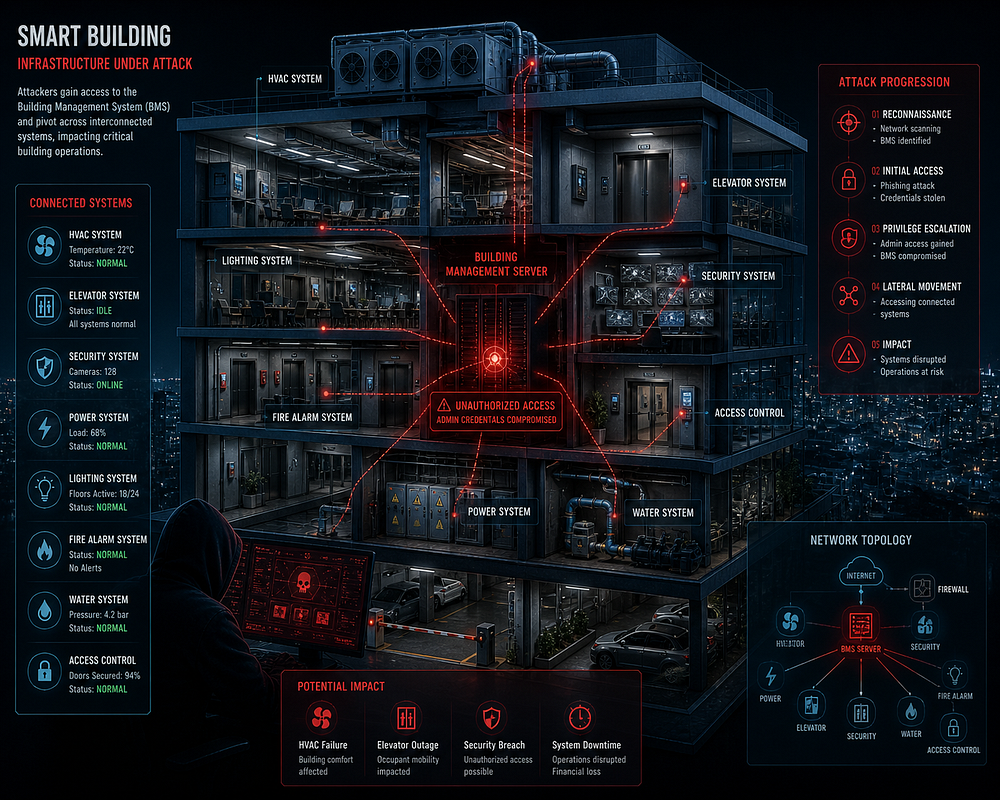
In April 2026, critical vulnerabilities were discovered in Cisco Integrated Management Controller (IMC), a device widely deployed in data centers, building management systems, and enterprise infrastructure. These vulnerabilities reveal a persistent truth about industrial security: attackers don’t start with hardened systems — they start with overlooked ones.
CVE-2026–20096: Command Injection in Cisco IMC
The vulnerability allows an authenticated remote attacker with admin privileges to perform command injection attacks and execute arbitrary commands as root. This is not a theoretical risk — it’s a complete system compromise pathway.
The root cause: improper validation of user-supplied input in the web-based management interface. Once an attacker gains admin-level access (through phishing, credential theft, or lateral movement), they can inject malicious commands that execute with root privileges.
What makes this particularly dangerous in building management contexts:
• Building management systems control physical infrastructure: HVAC, power distribution, access control
• These systems often operate in assumed-trusted environments and aren’t continuously monitored
- They frequently connect to — or bridge between — IT and OT networks, creating lateral movement pathways
The Broader Pattern
April 2026 vulnerability disclosures affected a layered attack surface:
• Industrial control systems and PLCs
• Building management and smart building systems
• Wireless OT infrastructure
• Remote access platforms (RDP, VNC)
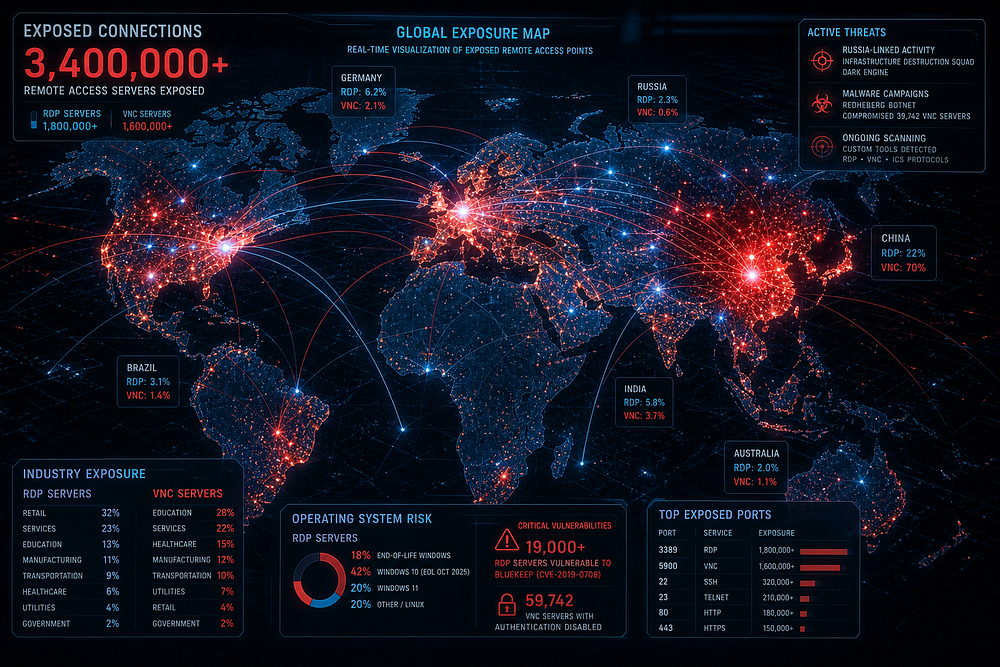
3.4 Million Exposed Remote Access Servers: An Open Invitation
Research from Forescout revealed the scale and distribution of critical exposure in remote access infrastructure. Using Shodan data, researchers identified:
• 1.8 million exposed RDP (Remote Desktop Protocol) servers
- 1.6 million exposed VNC (Virtual Network Computing) servers
Geographic Distribution and Risk
The exposure is globally distributed, with concentrations in:
• China: 22% of exposed RDP, 70% of exposed VNC
• United States: 20% of exposed RDP, 7% of exposed VNC
• Germany and other nations are also showing significant exposure
Critical Infrastructure at Risk
After filtering for legitimate industry mapping, Forescout identified:
• 91,000 exposed RDP servers mapped to specific industries
• 29,000 exposed VNC servers mapped to specific industries
670 VNC servers providing direct, unauthenticated access to ICS/OT (industrial control and operational technology) control panels.
Vulnerable Systems in Critical Sectors
Industry distribution reveals persistent exposure in sectors managing essential services:
RDP exposure by sector: Retail (32%), Services (23%), Education, Manufacturing, and Transportation
VNC exposure by sector: Education (28%), Services (22%), Healthcare, Manufacturing, Transportation, and Utilities
Many of these servers run outdated or end-of-life operating systems. Forescout found:
• 18% of exposed RDP servers running end-of-life Windows versions
• 42% running Windows 10 (which reached end of support in October 2025)
• 19,000+ RDP servers still vulnerable to BlueKeep (CVE-2019–0708), a critical remote code execution vulnerability from 2019
Nearly 60,000 VNC servers have authentication disabled entirely. This is not a misconfiguration — it’s systemic exposure at scale.
Active Exploitation
These exposed systems are not being left alone. Forescout documented active exploitation:
• Russia-linked hacking groups (Infrastructure Destruction Squad and Dark Engine) are actively targeting these systems
• Threat actors sharing custom scanning tools designed for RDP, VNC, and OT-specific protocols
• REDHEBERG botnet has already compromised nearly 40,000 exposed VNC servers since February 2026
Supply Chain Breach: Itron and the Smart Meter Incident
In April 2026, Liberty Lake, Washington-based Itron Inc. — a major supplier of smart meters, grid sensors, and energy management infrastructure — disclosed a cyberattack that serves as a case study in supply chain vulnerability.
What Is Itron?
Itron is a critical infrastructure vendor with a vast footprint:
• Provides technology to over 7,700 utility providers across 100 countries
• Smart meter devices connected to 110+ million homes and businesses globally
• Integrated with energy grids, water systems, and gas distribution networks
Partners with major technology providers, including Cisco, on smart city infrastructure and IoT connectivity.
The Breach
On April 13, 2026, Itron was notified of unauthorized third-party access to its corporate systems. The company filed an 8-K with the SEC on April 24, disclosing the incident. Key details:
• Initial access: April 13, 2026
• Detection/notification: April 24, 2026 (11-day dwell time)
• Scope: Limited to internal corporate systems; no unauthorized activity observed in customer-hosted systems
An 11-day detection window is substantial enough time for attackers to establish persistence, map systems, exfiltrate data, or plant backdoors for future access.
Why This Matters
Supply chain attacks don’t need immediate operational impact to be dangerous. A breach of Itron’s internal systems raises serious questions:
• Did attackers gain visibility into deployment patterns? Knowing which utilities use specific Itron systems enables targeted downstream attacks.
• Were customer support credentials or vendor access tokens compromised? These could enable direct attacks on utility networks.
• Was code or firmware access obtained? Supply chain insertion into smart meter software would affect every downstream customer.
• What intelligence about grid architecture or weak points was gathered for future targeting?
OT Security Tools Become Attack Vectors
A particularly concerning development: vulnerabilities in defensive security tools themselves.
CVE-2026–6807: GrassMarlin XML External Entity (XXE) Vulnerability
In April 2026, CISA issued ICS Advisory ICSA-26–118–01 for a critical vulnerability in GrassMarlin, an OT network security analysis tool originally developed and open-sourced by the NSA.
The vulnerability: An XML External Entity (XXE) information disclosure flaw that allows a local attacker to deliver a crafted session file that leaks sensitive data from systems analyzing ICS and SCADA networks.
The practical impact: GrassMarlin users analyzing critical infrastructure networks for vulnerabilities could inadvertently leak network diagrams, system architectures, device inventories, and security assessments through this vulnerability.
Complicating the situation: GrassMarlin reached end-of-life in 2017. The NSA GitHub repository is now archived and read-only. No vendor patch will be issued. CISA recommends immediate retirement of active deployments and isolation of any legacy instances from live network segments.
This case illustrates a painful security reality: defensive visibility tools introduce their own risks. When security tools themselves expose sensitive data, they break a core assumption that defenders rely on.
Mirai and IoT Devices: Old Threats, New Detection
The Mirai botnet, first discovered in 2016, continues to target vulnerable IoT devices. In April 2026, security researchers at Darktrace documented a case where Mirai compromised an industrial surveillance camera, highlighting a persistent vulnerability: IoT devices remain poorly secured and widely exposed.
What’s changed is not the attacks — it’s the detection. AI-driven behavioral monitoring identified activity that traditional tools missed: anomalous executable downloads, rare external connections, and large data transfers to a C&C server in China, along with DDoS participation.
The case illustrates the problem: IoT surveillance devices, cameras, and edge hardware remain primary botnet targets because they lack traditional endpoint security, receive infrequent updates, and operate in trusted-by-default network environments.
Attacks aren’t always louder — they’re just less visible without behavioral monitoring.
AI Is Accelerating the Entire Threat Battlefield
The most significant development in April 2026 wasn’t a single incident — it was the formal disclosure that advanced AI models can now discover zero-day vulnerabilities autonomously, at machine speed, and with minimal human involvement.
Claude Mythos Preview and Project Glasswing
On April 7, 2026, Anthropic disclosed that Claude Mythos Preview — a cybersecurity-focused model — had autonomously discovered thousands of high- and critical-severity vulnerabilities, including previously unknown zero-days in code dating back decades.
Rather than a public release, Anthropic restricted access through Project Glasswing, providing controlled access to twelve launch partners and over 40 additional organizations maintaining critical infrastructure — exclusively for defensive security work.
Documented Zero-Day Discoveries
Testing documented specific zero-day vulnerabilities discovered by Mythos Preview:
• A 27-year-old denial-of-service vulnerability in OpenBSD’s TCP SACK implementation
• A 16-year-old vulnerability in FFmpeg’s H.264 codec (introduced in 2003, overlooked since 2010)
• A 17-year-old remote code execution flaw in FreeBSD NFS server (CVE-2026–4747), granting unauthenticated root access
All discovered and fully exploited without human involvement after the initial prompt.
Structural Shift in Vulnerability Discovery
This represents a fundamental shift in the threat equation. For decades, finding zero-days required deep technical expertise, years of experience, and months of research cycles. Only elite threat actors and well-funded nation-states could do it consistently.
That barrier has collapsed. AI models can now:
• Autonomously scan codebases and identify exploitable flaws
• Build working exploits across operating systems and applications
• Discover flaws surviving decades of human review
• Enable attackers without specialized coding knowledge to exploit sophisticated vulnerabilities
Rapid Weaponization
CrowdStrike’s 2026 Global Threat Report found that lateral movement across networks now occurs in 29 minutes — a 65% acceleration from 2024. The fastest recorded breakout happened in just 27 seconds. AI is compressing the entire attack timeline.
April 2026’s Patch Tuesday from Microsoft — delivering fixes for roughly 169 vulnerabilities — reflected this shift. The patch cycle included elevation-of-privilege flaws rather than classic RCE bugs. This pattern is consistent with AI-assisted discovery, which excels at finding subtle privilege boundary violations that chain with existing footholds.
If your response model is still manual and reactive, you’re not just behind — you’re fundamentally outpaced by machine-speed threat discovery and exploitation.
Geopolitical Escalation: Iranian Cyber Operations Shift from Espionage to Disruption
Cyber operations linked to geopolitical tensions are becoming more aggressive. Iranian-affiliated threat actors, historically focused on espionage, are moving into disruption — deploying data-wiping malware and targeting industrial systems directly.
Iranian Cyber Escalation Pattern
Iran has a documented history of using cyber operations for retaliation and coercion:
• 2011–2013: Disabling U.S. financial websites
• 2012–2016: Shamoon, ZeroCleare, and Dustman wiper malware targeting Middle Eastern energy and industrial sectors
• 2020–2021: Infrastructure disruptions and website defacement following political events
In 2026, escalation continued through multiple coordinated threat actors and hacktivist collectives.
Stryker Medical Devices Attack
In March 2026, Stryker Corporation, a major U.S. medical technology company, suffered a devastating cyberattack claimed by Handala, a pro-Iranian hacker group linked by researchers to Iran’s Ministry of Intelligence and Security.
Rather than seeking ransom, the attack deployed destructive malware that permanently wiped approximately 200,000 devices across Stryker’s global network. This caused:
• Operational shutdowns in 79 countries
• Manufacturing and logistics disruptions
• Healthcare delivery impacts — hospitals dependent on Stryker equipment experienced delays and shortages
• Tens of thousands of employees idled by the disruption
Technical Shift: From Malware to Administrative Abuse
A critical technical evolution: Iranian cyber actors have moved from deploying custom-built wiper malware to abusing legitimate administrative tools.
In the Stryker incident, attackers leveraged compromised admin credentials to Microsoft Intune (mobile device management) and issued legitimate remote-wipe commands to ~200,000 devices. This approach:
• Evades traditional malware detection — no malicious binaries or suspicious file execution
• Uses native administrative tools, blending into normal system activity
• Achieves the same destructive impact through ‘living off the land’ techniques
Industrial Control System Targeting
On April 7, 2026, CISA and the FBI issued an advisory documenting Iranian-affiliated APT actors targeting internet-exposed programmable logic controllers (PLCs) across U.S. critical infrastructure sectors.
Since at least March 2026, these actors have:
• Targeted Rockwell Automation/Allen-Bradley devices
• Maliciously manipulated project files (ladder logic and configuration settings)
• Altered data displayed on HMI (Human-Machine Interface) and SCADA systems
Affected sectors include Government Services and Facilities, Water and Wastewater Systems, and Energy. Some victims experienced operational disruption and financial loss.
This marks a significant shift in intent. The goal is no longer just access — it’s impact.
The Data Confirms What the Industry Already Knows
Industry surveys paint a consistent but troubling picture:
1. 96% of OT incidents originate from IT compromises
2. 60% of organizations experienced incidents in 2025
3. 88% increased security spending
Yet incidents persist. Why? Because the core issue isn’t funding — it’s architecture.
As long as IT and OT environments remain interconnected without unified security strategies, compromise in one will continue to cascade into the other. Increased budgets don’t fix fundamentally insecure architectural decisions.
Ransomware caused 90% of losses in critical infrastructure despite representing only 12% of claims between March 2021 and February 2026. The concentration of impact in a single attack type illustrates how vulnerabilities in OT systems create outsized operational consequences.
The Gap Between Compliance and Reality
April 2026 didn’t reveal a single catastrophic failure. It revealed something more concerning: a consistent mismatch between how systems are secured and how they are actually attacked.
Organizations are still:
• Trusting networks that shouldn’t be trusted
• Exposing systems that should never be public
• Relying on tools that introduce their own risks
Meanwhile, attackers are scaling, automating, and adapting at machine speed.
The incidents of April 2026 show that static compliance-driven security, checklists, vulnerability scans, and periodic assessments cannot keep pace with the current threat landscape. The illusion of control is breaking because the underlying assumptions were always insufficient.
The bottom line is simple:
If your OT security strategy is static, compliance-driven, or built on assumptions of isolation, you’re already behind.
The time for incremental improvements has passed. What’s required now is structural redesign: Zero Trust architecture, unified IT-OT security strategies, behavioral monitoring at machine speed, and acceptance that security is not a state to achieve but a continuous process to maintain.


Comments
Post a Comment