Strategic Industrial Cyber Warfare Analysis — Briefing 08
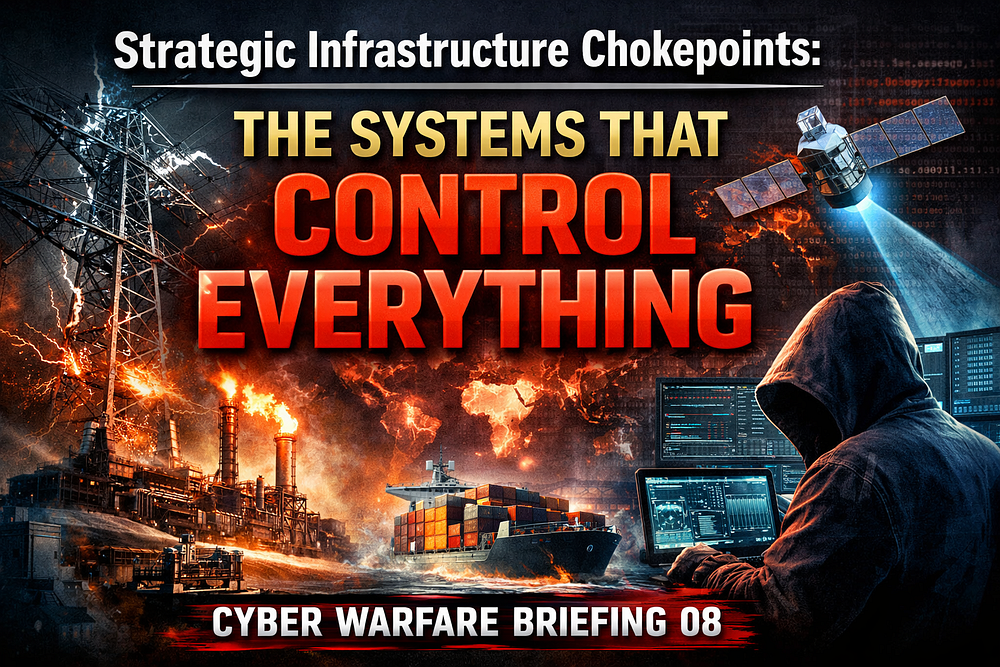
Strategic Infrastructure Chokepoints: The Systems That Control Everything
Key Judgments
• Modern societies depend on a small number of critical infrastructure chokepoints that concentrate systemic risk.
• These chokepoints are not always the largest systems but the ones that everything else depends on.
• Disrupting a single chokepoint can trigger cascading failures across multiple sectors simultaneously.
• Nation-state cyber strategy is increasingly focused on identifying, mapping, and pre-positioning access within these high-leverage targets.
• Control over chokepoints provides disproportionate strategic power, making them primary objectives in cyber conflict.
Strategic Context
Previous briefings established:
- infrastructure as the battlefield
- long-term shaping operations
- deterrence and restraint
- grey zone conflict
- cyber-physical sabotage
- AI-driven warfare
- loss of human control
This progression leads to a critical strategic realization:
Not all infrastructure is equal. Some systems matter more than others.
And within complex infrastructure networks, there exist chokepoint nodes where disruption creates an outsized impact.
Understanding these chokepoints is essential to understanding how modern cyber warfare is actually fought.
What Are Infrastructure Chokepoints?
Infrastructure chokepoints are systems, nodes, or dependencies that:
- Multiple sectors rely on simultaneously
- cannot be easily replaced or bypassed
- amplify disruption across interconnected systems
They are not always visible.
They often operate quietly in the background until they fail. These chokepoints act as force multipliers. A small disruption at the right point can produce system-wide consequences.
Types of Strategic Chokepoints
Chokepoints exist across multiple layers of modern infrastructure.
Energy Synchronization Nodes
Power grids rely on precise synchronization.
Disrupting frequency stability or grid coordination points can:
- destabilize large regions
- trigger cascading outages
- impact all dependent sectors
Telecommunications Core Networks
Core routing and switching systems enable:
- national communication
- internet connectivity
- emergency coordination
Disruption at this level affects entire communication ecosystems.
Satellite and Timing Systems
Global systems rely on precise timing signals for:
- financial transactions
- navigation
- industrial synchronization
Interference can create widespread systemic misalignment.
Industrial Control Gateways
Points where IT and OT systems connect:
- remote access systems
- centralized control platforms
- cloud-integrated industrial systems
These act as entry points into physical processes.
Supply Chain Control Systems
Logistics platforms coordinate:
- transportation
- inventory
- distribution networks
Disruptions here can halt entire economic flows.
Why Chokepoints Matter
Chokepoints concentrate risk. Instead of attacking multiple targets, an adversary can:
- Identify a single critical dependency
- disrupt it
- allow cascading effects to propagate naturally
This creates maximum impact with minimal effort.
It also increases:
- deniability
- efficiency
- strategic leverage
Because the visible damage appears distributed…
while the cause remains centralized.
Cascading Failure Dynamics
Modern infrastructure is tightly interconnected. This means disruption rarely stays contained.
A failure in one chokepoint can cascade into:
- Energy outages are affecting telecommunications
- Telecom failures are disrupting logistics
- logistics disruptions impacting industrial production
- industrial slowdown affecting economic stability
These cascading effects amplify the original disruption.
Turning a localized event…
into a systemic crisis.
Strategic Targeting in Cyber Warfare
Nation-state cyber strategy increasingly focuses on:
- mapping dependencies across infrastructure
- identifying high-leverage nodes
- pre-positioning access within chokepoints
Rather than attacking broadly, adversaries aim to:
- control key nodes
- maintain persistence
- activate disruption when strategically advantageous
This aligns with earlier briefings:
- shaping operations prepare access
- Deterrence limits overt attacks
- grey zone operations test boundaries
Chokepoints become the ultimate targets within this framework.
The Power of Indirect Control
One of the most important insights:
Control over chokepoints allows indirect control over entire systems.
An attacker does not need to:
- Shut down every power plant
- disrupt every network
- target every facility
Instead, they can:
- influence a central dependency
- allow the system to destabilize itself
This makes chokepoint control one of the most efficient and strategic forms of cyber power.
Implications for Defense
Defending infrastructure requires a shift in focus.
Security cannot treat all assets equally.
Instead, it must prioritize:
- identification of critical dependencies
- protection of high-impact nodes
- segmentation to limit cascading effects
- resilience planning for chokepoint failure
The goal is not just to prevent attacks.
It is to ensure that no single point of failure can destabilize the entire system.
Strategic Outlook
As infrastructure becomes more interconnected, chokepoints will become:
- more critical
- more valuable
- more targeted
Future cyber conflicts will likely focus on:
- subtle manipulation of key nodes
- coordinated disruption across dependencies
- strategic timing of chokepoint activation
The most significant attacks may not appear as widespread campaigns.
They may appear as:
- isolated failures
- technical anomalies
- localized disruptions
That gradually reveal themselves as systemic events.
Final Insight
In modern cyber warfare. Power is not defined by how many systems you can attack.
It is defined by whether you understand
Which system matters most.
Because the system that everything depends on…Is the system that controls everything.


Comments
Post a Comment