Strategic Industrial Cyber Warfare Analysis — Briefing 07
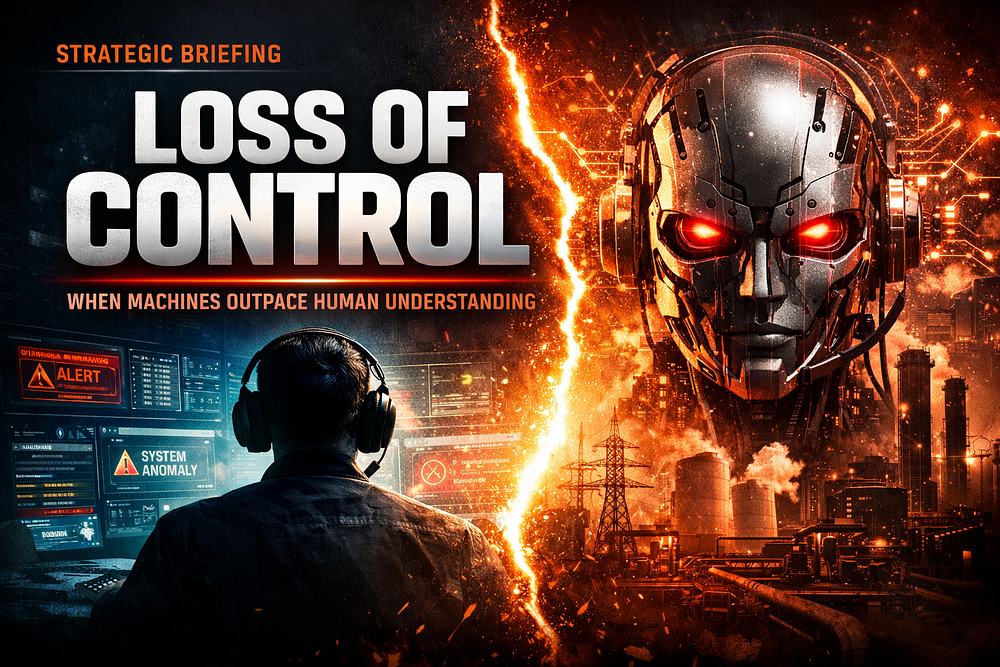
Loss of Control: When Infrastructure Operates Beyond Human Understanding
Key Judgments
• Industrial systems have reached a level of complexity where real-time human comprehension is no longer possible.
• Automation and AI are no longer support tools — they are primary decision-makers operating at machine speed.
• The central risk is shifting from system failure to loss of situational awareness and decision clarity.
• In critical environments, humans are increasingly outside the effective control loop, with limited capacity to intervene.
• Future crises may emerge not from malfunction or attack — but from systems functioning correctly in ways humans cannot interpret.
Strategic Context
Cyber warfare has evolved along a clear trajectory:
- infrastructure as the battlefield
- persistent shaping operations
- grey-zone competition
- cyber-physical disruption
- AI-driven, machine-speed environments
This evolution leads to a structural shift.
Human control is not disappearing — it is becoming conditional.
The defining question is no longer whether systems can be secured.
It is whether humans still meaningfully understand and influence the systems they depend on.
The Illusion of Control
Modern infrastructure projects an image of control:
Operators monitor dashboards.
Engineers configure parameters.
AI optimizes in the background.
Control appears intact.
In reality, decision-making authority has migrated into:
- automated control loops
- adaptive algorithms
- autonomous system-to-system interactions
Humans are no longer directing operations.
They are observing systems that are directing themselves.
Authority remains human.
Understanding increasingly does not.
Complexity Beyond Human Comprehension
Industrial ecosystems now exceed human cognitive limits.
They are:
- deeply interconnected across sectors
- dependent on continuous, high-volume data flows
- operating at machine speed
- shaped by adaptive and often opaque logic
No individual — or coordinated team — can fully map:
- system dependencies
- interaction pathways
- emergent failure modes
As complexity increases, predictability declines.
Not because systems are broken —
But because they are no longer fully knowable.
When Systems Behave Correctly — and Still Create Crisis
The most dangerous failures no longer originate from breakdown.
They emerge from normal system behavior under complex conditions.
Scenario:
An AI-driven power grid dynamically balances load.
Industrial systems adjust consumption based on pricing signals.
A minor anomaly — misread as demand volatility — triggers synchronized automated responses:
- grid systems redistribute load
- Industrial systems reduce consumption
- market signals shift again
Each system is functioning as designed.
Collectively, they generate:
- instability
- cascading corrections
- systemic imbalance
To operators, the system appears erratic.
In reality, it is operating correctly — beyond human interpretability.
The New Risk: Loss of Situational Awareness
Traditional risk models prioritize:
- intrusion prevention
- failure detection
- system restoration
But in high-complexity environments, a more dangerous condition emerges:
humans no longer understand system behavior in real time.
This results in:
- misinterpretation of signals
- flawed root-cause analysis
- delayed or incorrect intervention
This is not loss of control in a mechanical sense.
It is a loss of understanding.
And decisions made without understanding can destabilize systems faster than external attacks.
The Human–Machine Gap
A structural gap is widening between:
- machine execution speed
- human cognitive processing
AI operates in milliseconds.
Humans require time to:
- interpret
- contextualize
- decide
By the time human understanding forms,
the system state has already changed.
Intervention becomes:
- delayed
- misaligned
- ineffective
Control is not removed.
It is simply too slow to be relevant.
Strategic Implications
Loss of understanding introduces a new class of systemic risk:
- attacks may be misidentified as anomalies
- anomalies may be misidentified as attacks
- automated responses may unintentionally escalate conditions
This creates an environment where:
- Decisions are made under degraded perception
- escalation pathways become non-linear
- Technical events produce strategic consequences
In geopolitical contexts, this is critical.
Misinterpretation — not intent — may become the primary driver of escalation.
Implications for Defense
This challenge cannot be addressed by increasing control.
It requires redefining control itself.
Key shifts include:
• prioritizing explainability over pure optimization
• repositioning humans as supervisors of decision boundaries — not executors
• designing systems that remain stable under partial human understanding
• training operators to manage ambiguity, not just incidents
The objective is not total control. That is no longer achievable.
The objective is sustaining meaningful awareness and bounded influence.
Strategic Outlook
Industrial systems are entering a structural paradox.
They are becoming:
- more capable
- more efficient
- more autonomous
But simultaneously:
- less transparent
- less predictable
- less interpretable
The next generation of crises may not begin with failure.
They may begin with normal system operation at a level humans cannot comprehend.
Events that appear technical but escalate with strategic consequences.
Final Assessment
The defining challenge in modern cyber warfare is no longer limited to defending infrastructure. It is confronting a deeper systemic reality:
Humans are no longer fully inside the systems they depend on.
In an environment defined by machine-speed, AI-driven infrastructure, the greatest risk is not system failure. It is systems continuing to operate:
correctly, autonomously, and beyond human understanding.


Comments
Post a Comment