Strategic Industrial Cyber Warfare Analysis — Briefing 06
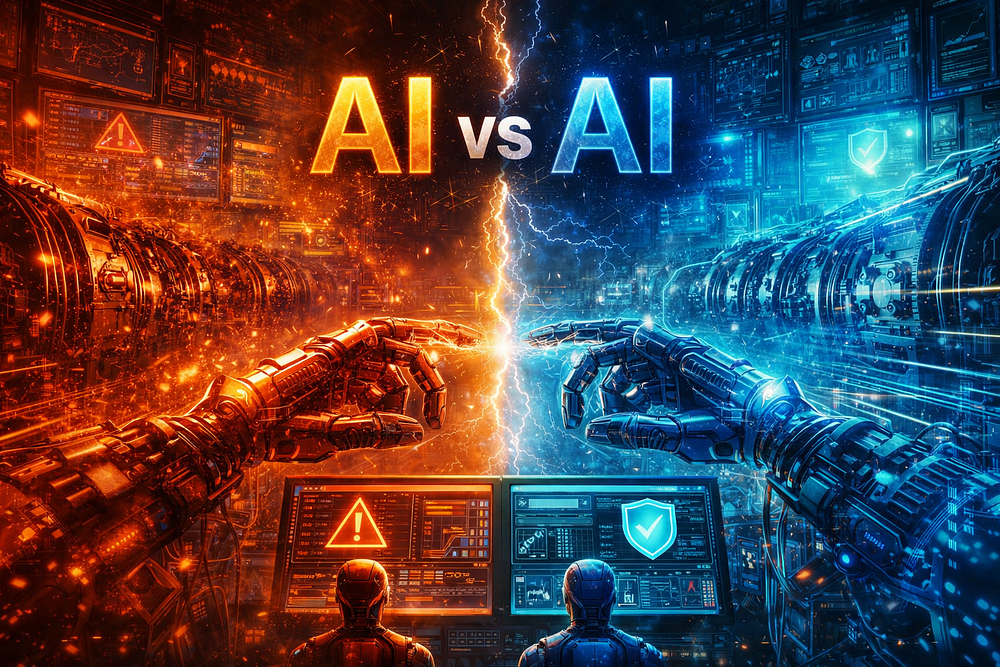
AI vs AI: Machine-Speed Warfare in Critical Infrastructure
Key Judgments
• Cyber conflict in industrial systems is rapidly evolving toward machine-speed operations, where AI systems detect, decide, and act faster than humans can respond.
• Both attackers and defenders are increasingly deploying artificial intelligence to automate cyber operations, creating AI vs AI dynamics.
• Decision-making windows in critical infrastructure are shrinking to seconds or milliseconds, reducing the role of human intervention.
• While AI enhances defensive capabilities, it also introduces risks of autonomous escalation, misjudgment, and system instability.
• The strategic advantage in future cyber conflict will depend on speed, adaptability, and control of automated systems.
Strategic Context
Previous briefings explored how cyber warfare has shifted toward infrastructure, long-term preparation, deterrence dynamics, grey zone operations, and cyber-physical sabotage.
This progression leads to a new reality.
Industrial systems are becoming:
- more automated
- more interconnected
- increasingly reliant on real-time decision-making
At the same time, cyber threats are becoming faster, more adaptive, and more complex.
This creates a critical mismatch.
Human operators cannot respond quickly enough to defend systems operating at machine speed.
As a result, artificial intelligence is becoming central to both offensive and defensive cyber operations.
The Shift to Machine-Speed Conflict
Industrial processes operate in real time.
Power grids must balance load instantly.
Telecommunications networks synchronize continuously.
Automation systems execute tasks in fractions of a second.
In this environment, cyber threats can propagate faster than human response times.
Traditional defense models — based on human monitoring and manual intervention — are no longer sufficient.
AI systems are now required to:
- detect anomalies instantly
- analyze patterns in real time
- initiate responses without delay
This marks the transition from human-speed cyber defense to machine-speed conflict.
AI vs AI Dynamics
As AI becomes embedded in infrastructure security, cyber conflict is evolving into automated competition between intelligent systems.
Offensive AI Capabilities
Adversaries may use AI to:
- identify vulnerabilities across complex systems
- adapt attack strategies dynamically
- evade detection by learning defensive patterns
- optimize timing and execution of attacks
Defensive AI Capabilities
Defenders deploy AI to:
- monitor system behavior continuously
- detect subtle anomalies in physical and digital processes
- respond automatically to threats
- isolate affected systems before damage spreads
This creates a feedback loop where:
- attack systems learn from defenses
- defense systems adapt to attacks
Resulting in a continuous cycle of AI-driven escalation and countermeasure.
Compression of Decision Time
One of the most significant impacts of AI-driven cyber conflict is the compression of decision-making time.
In traditional systems:
- humans detect
- humans decide
- humans respond
In machine-speed environments:
- AI detects
- AI decides
- AI acts
This reduces response times from minutes…
to seconds…
to milliseconds.
While this improves reaction speed, it also introduces a critical challenge:
Humans are no longer in full control of the decision loop.
Risks of Autonomous Conflict
The integration of AI into cyber operations introduces new and complex risks.
Autonomous Escalation
AI systems may respond to perceived threats in ways that escalate conflict beyond intended limits.
Misinterpretation of Data
False positives or incorrect pattern recognition could trigger unnecessary or harmful responses.
Conflicting AI Systems
Different AI systems — across organizations or nations — may interact unpredictably, creating instability.
Loss of Human Oversight
As decision speed increases, human operators may struggle to intervene effectively.
These risks highlight a fundamental tension:
AI increases capability…
but reduces control.
Strategic Advantage and Vulnerability
In a machine-speed environment, advantage shifts toward those who can:
- deploy faster detection systems
- adapt more quickly to changing conditions
- maintain control over automated responses
However, this advantage is fragile.
The same systems that enable rapid defense can also:
- amplify errors
- propagate failures
- create cascading effects across interconnected infrastructure
This creates a dual reality:
AI is both a force multiplier and a risk multiplier.
Implications for Critical Infrastructure
For industrial systems, AI-driven conflict changes the nature of defense.
Security strategies must now account for:
- real-time process monitoring
- integration of AI into operational decision-making
- coordination between human operators and automated systems
- safeguards to prevent unintended escalation
The focus is no longer just on preventing intrusion.
It is on maintaining control under conditions of high-speed, automated conflict.
Strategic Outlook
AI vs AI conflict represents the next phase of cyber warfare evolution.
As infrastructure systems become more intelligent and interconnected, cyber operations will increasingly occur:
- at speeds beyond human comprehension
- through automated decision-making
- within complex, adaptive systems
Future conflicts may not be defined by visible attacks or clear timelines.
Instead, they may unfold as:
- rapid sequences of automated actions
- subtle system adjustments in real time
- continuous adaptation between opposing AI systems
All occurring faster than humans can fully observe or understand. The central challenge for the future is not just building smarter systems. It is ensuring that humans retain meaningful control over them.
Because in machine-speed warfare…
The greatest risk is not that systems will fail.
It is that they will act…
before anyone fully understands the consequences.


Comments
Post a Comment