Strategic Industrial Cyber Warfare Analysis - Briefing 02
Cyber Shaping Operations: How Nations Prepare the Battlefield Years Before War
Key Judgments
• Modern industrial cyber attacks are often preceded by years of preparation, rather than being spontaneous strikes.
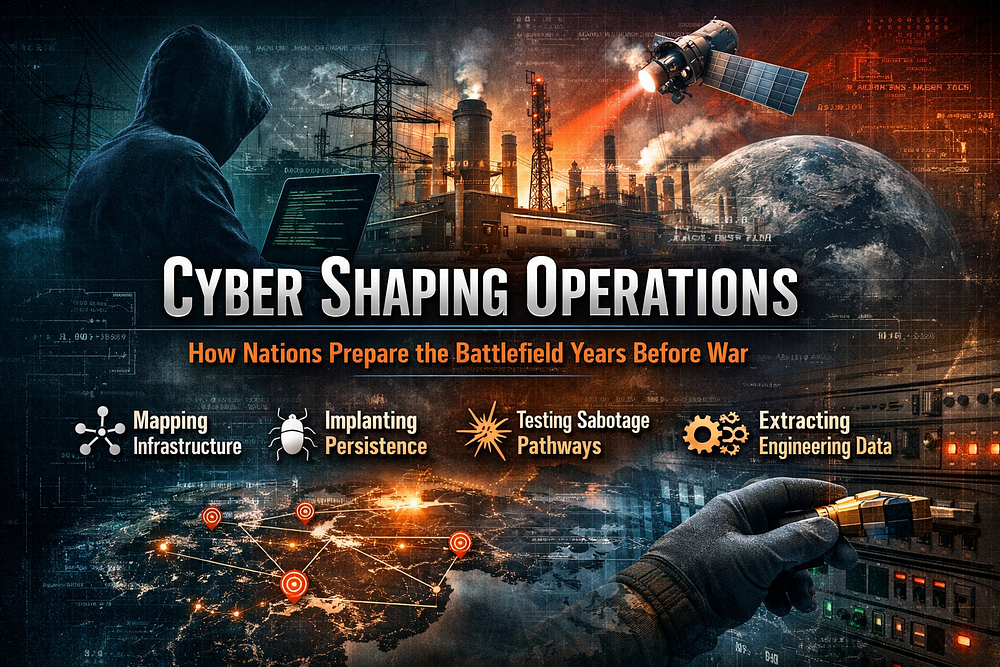
• Adversaries conduct operations to map infrastructure, implant persistence, test sabotage pathways, and extract engineering data, all without immediate effect.
• These “shaping operations” create strategic advantage, allowing states to plan and calibrate potential future attacks with precision.
• Understanding and monitoring such pre-attack activities is critical for national security, as these operations can go unnoticed until they are exploited in a conflict.
• Industrial cyber defense must shift from reactive incident response to proactive intelligence-driven strategies.
Strategic Context
In the previous briefing, we identified infrastructure as the next battlefield in cyber conflict. This briefing examines the activities that occur long before a visible attack, what military strategists call cyber shaping operations.
Across the globe, states are quietly preparing the battlefield in industrial environments. These operations often take years to execute, embedding intelligence, access, and influence into critical systems long before a conflict appears imminent.
The goal is not immediate disruption. It is a strategic positioning, ensuring that when the time comes, attackers can operate with precision and leverage.
Cyber Shaping Operations: The Methods
Nations conduct a variety of preparatory cyber activities in industrial systems, including:
1. Mapping Infrastructure
Detailed reconnaissance identifies critical systems, network topology, and interdependencies.
Attackers seek to understand how energy, transportation, and manufacturing systems function, including chokepoints and redundancies.
2. Implanting Persistence
Long-term access is established through subtle backdoors, compromised vendor accounts, or embedded firmware changes.
These persistent footholds allow adversaries to remain undetected while monitoring operations for years.
3. Testing Sabotage Pathways
Simulated disruptions or small-scale manipulations test the impact of attacks.
This allows operators to measure system tolerances without triggering visible failures.
4. Extracting Engineering and Operational Data
Detailed technical intelligence is collected, including process parameters, automation logic, and control sequences.
This information allows future attacks to precisely target vulnerabilities with minimal chance of detection.
Strategic Insight
Unlike traditional IT cyber attacks, these operations are not about stealing data for immediate gain. They are about preparing the battlefield.
By embedding access and knowledge over time, adversaries gain:
- Operational advantage — understanding exactly how to disrupt systems efficiently.
- Flexibility — the ability to choose when and how to act.
- Deniability — shaping activities can be conducted without clear attribution.
In other words, many industrial cyber attacks are the culmination of years of preparation, not sudden events. This makes defensive intelligence and monitoring just as important as firewalls or incident response teams.
Implications for Defense
Defenders can no longer rely solely on perimeter security or reactive strategies.
Effective defense against shaping operations requires:
- Active monitoring of system behavior to detect subtle anomalies.
- Auditing the vendor and remote access to ensure no persistent footholds are hidden.
- Red team simulations that anticipate adversary preparation techniques.
- Resilience engineering to ensure systems can absorb potential disruption even if adversaries are already embedded.
Proactive threat intelligence is critical, as waiting until an attack manifests may be too late.
Strategic Outlook
Cyber shaping operations demonstrate that industrial cyber warfare is rarely about immediate results. Instead, it is about long-term advantage, subtle positioning, and strategic leverage. Nations investing in infrastructure mapping, access implantation, and sabotage testing create future options for coercion, disruption, or war.
For defenders, the key question is no longer “how do we stop attacks?”
It is:
How do we know if the battlefield has already been prepared against us?
As industrial systems become more connected, integrated, and AI-enabled, the potential for adversaries to quietly shape the battlefield will increase dramatically.
Proactive intelligence, resilience, and anticipation are no longer optional, they are essential to protecting the infrastructure that sustains society.


Comments
Post a Comment