Strategic Cybersecurity Updates: Machine-Speed Defense
Critical infrastructure security is quickly evolving. New reports show artificial intelligence being integrated into OT (Operational Technology) protections for power grids, factories, telecom networks, and more, even as agencies raise alarms about new ICS (Industrial Control Systems) vulnerabilities.
Industry data highlight a sharp rise in threats: in 2025, the U.S. CISA issued over 450 new advisories on ICS products, and researchers recorded 2,065 CVEs for industrial systems, the highest number ever documented. Similarly, a national report found that fully 73% of reported cyber incidents in 2024 targeted OT environments.
These trends, more vulnerabilities, and more attacks are driving increased investment in new defenses. Many organizations are now deploying dedicated hardware and AI-powered monitoring tools to detect and block intrusions in real time.
Essentially, cybersecurity for critical systems is shifting to “machine speed”: adversaries automate attacks with AI, and defenders respond with AI systems that identify and halt threats immediately. The future will depend on blending human expertise with these autonomous defenses.
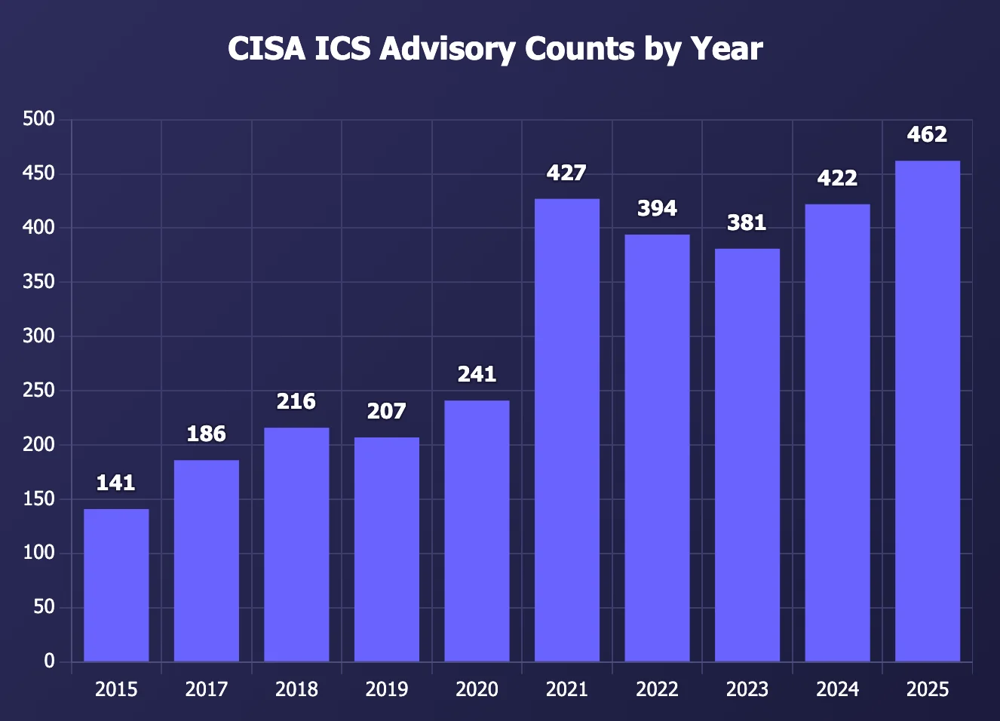
Industrial control system vulnerabilities have surged in recent years. For example, official data show ICS advisories reaching record highs: CISA logged over 450 new ICS bulletins in 2025.
Similarly, analyses revealed a total of 2,065 ICS CVEs in 2025, a significant increase from previous years. This rise reflects expanding attack surfaces (IT/OT convergence) and increased scrutiny of legacy equipment. At the same time, incidents have also risen: one national OT report noted that in 2024, 73% of cyberattacks targeted OT systems (up from 49% in 2023).
The report warned that “cybersecurity cannot be bolted on and must be built in” to protect people and processes. In summary, organizations now face a flood of new industrial vulnerabilities (many in unsupported hardware and protocols) and an increasing wave of OT attacks across various sectors.
AI-Accelerated Attacks on OT
Attackers are already using AI to operate at machine speed. Experts note that even if fully autonomous AI bots are not yet common, adversaries utilize AI to enhance traditional attacks. For example, AI tools can automate network reconnaissance, create highly-targeted spear-phishing campaigns, and even develop custom exploit code in minutes — tasks that previously took teams of specialists weeks.
Studies highlight this impact: one analysis revealed that phishing emails generated by AI had a 54% click-through rate, compared to only 12% for typical human-created lures. As a Deloitte threat report states, “Threat actors are automating reconnaissance and launching tailored phishing attacks to deploy malware… that place organizations across industries at risk of cyber-attack”. In practical terms, this means criminals leverage AI as a force multiplier — compressing attack cycles and expanding their reach. The result is an asymmetrical threat: attackers can iterate and adapt at computer speed, constantly probing for new entry points, while defenders struggle to keep pace.
AI-Driven, Machine-Speed Defense
Defenders are responding in kind by adopting AI and hardware-based security at machine speed. Modern OT defense platforms embed AI/ML analytics and dedicate specialized hardware to handle security tasks without slowing operations. For example, NVIDIA and its partners have developed architectures in which data processing units (DPUs) run intrusion detection and zero-trust segmentation on dedicated chips at the network edge. In this model, control-network traffic is mirrored to a separate security processor that continuously enforces policies, so protection remains isolated from critical control systems.
Likewise, centralized “AI factory” engines can aggregate telemetry from thousands of OT sensors, analyze it on GPUs, and then instantly push refined detection models back to edge devices. The key is real-time automation: AI-based monitors watch every packet and control signal in real time at millisecond speed. When a threat is detected, autonomous containment kicks in immediately: infected segments are isolated, and malicious flows are blocked on the fly. In trials, such machine-speed responses have proven to be orders of magnitude faster than human teams. By continuously learning from new data, these systems improve over time and can even preempt emerging tactics. Essentially, defenders deploy “virtual immune systems” that block novel attacks before they affect operations.
In practice, many industrial organizations now use anomaly-detection AI designed for OT. These systems create a baseline of normal device behavior (PLC readings, control loop timings, etc.) and identify any deviations. For example, Darktrace states that the adoption of AI “to protect, detect, respond, and recover from cyber incidents in industrial systems is paramount for keeping critical infrastructure safe”.
Using self-learning models avoids dependence on static signatures and helps detect zero-days or insider threats. When AI issues an alert, some solutions can automatically isolate PLCs, disconnect network links, or revert suspicious changes. Along with traditional practices (network segmentation, strict authentication, encrypting control traffic), AI-driven defenses form a layered, hardware-accelerated shield that can keep pace with automated threats.
Human-AI Teaming
Even with these tools, human expertise remains vital. Experts warn that AI won’t fully replace security teams; instead, collaboration is key. An industry report highlights that “AI will not be able to replace human teams fully… the best approach combines human judgment with AI speed”. This means that automated systems handle monitoring and initial responses, while skilled analysts interpret alerts, hunt for complex threats, and make strategic decisions. To facilitate this cooperation, new AI tools are emerging.
For instance, UK researchers recently launched an AI “chatbot” for ICS security that answers operator questions in plain language, aiming to “speed up decision-making during fast-moving cyber incidents”. These tools can lessen cognitive load and prevent human teams from being overwhelmed by alerts. Ultimately, the most effective defense is a human-machine team: AI enables rapid detection and containment, while human engineers oversee operations, investigate incidents, and work on ongoing improvements [13][14].
Real-World Examples
· Stopping Ransomware in Healthcare: In one case study, an AI security system was credited with detecting and halting a ransomware attack on a hospital’s network before files could be encrypted. The report notes that the AI’s real-time intervention “minimized the damage,” protecting critical systems and patient data.
· Protecting Manufacturing OT: A large manufacturer deployed an AI-driven endpoint security agent (Cylance) to safeguard its industrial control systems. According to that case, the AI “successfully prevented a targeted malware attack that could have disrupted production lines,” demonstrating its ability to block threats before operations were affected.
These examples illustrate how machine-speed defenses can avert disasters by neutralizing threats in flight, complementing the human team rather than waiting on it.
Recommendations for Machine-Speed Resilience
· Build Security In (Secure-by-Design): Treat OT security as foundational. Invest in modernizing legacy systems and architecting networks for security from the ground up. Agencies urge leaders to embed cybersecurity into all engineering and procurement decisions, noting that true resilience comes from security “built in” rather than bolted on.
· Leverage AI and Hardware: Deploy AI-driven monitoring across OT networks. Use dedicated hardware (e.g., DPUs, secure gateways, FPGAs) to offload security tasks, enabling full-speed packet inspection and enforcement. Studies show that AI can reduce response times by roughly 70% compared to traditional methods. Continuous, automated anomaly detection and isolation should be standard components of OT defenses.
· Adopt Zero Trust Segmentation: Implement strict microsegmentation and least-privilege access for OT zones. As threats accelerate, limiting lateral movement is critical. Enforce multifactor authentication for vendor and remote access, and zero-trust policies for inter-device communication. These architectural measures slow attackers and give AI defenders more time to react.
· Integrate Human Expertise: Recruit and train personnel skilled in both OT processes and cybersecurity. Facilitate collaboration between IT and OT security teams (“breaking down silos,” as recommended ). Provide analysts with AI tools (such as ICS Q&A agents or threat dashboards) to enable rapid, informed decisions. Remember that experts are needed to tune AI models, investigate complex incidents, and interpret ambiguous alerts.
· Share Intelligence and Train Constantly: Establish cross-sector information-sharing to keep pace with attackers. Participate in CISA advisories and industry working groups. Practice incident response with drills tailored to ICS scenarios. Invest in workforce development: one report warns of a “dangerous gap” in OT cybersecurity talent, underscoring the urgency of proactive training and education.
Implementing machine-speed defenses effectively requires a comprehensive approach: secure design, automated detection, hardware support, and most importantly, coordination between intelligent systems and skilled humans. By integrating these elements, infrastructure operators can shift the advantage back to the defender — even as the cyber arms race accelerates.
— — — — — — — — — — — — — — — — — — — — — — — — — — — — — — — — — — — —
Sources: Current industry and academic research on OT/ICS security and AI-driven cybersecurity[1][2][3][4][6][7][10][8][9][12][16][20][14][13]. These sources report on vulnerability trends, AI threat use cases, and the deployment of AI/hardware defenses in critical infrastructure. Each insight is drawn from expert analyses and case studies as cited.
[1] [17] [19] Canadian Cybersecurity Network report highlights surge in OT cyber incidents, rising critical infrastructure vulnerabilities — Industrial Cyber https://industrialcyber.co/reports/canadian-cybersecurity-network-report-highlights-surge-in-ot-cyber-incidents-rising-critical-infrastructure-vulnerabilities/
[2] [3] CISA Industrial Control Systems (ICS) Advisories Recap for 2025 https://socradar.io/blog/cisa-industrial-control-systems-ics-advisories-2025/
[4] [5] AI accelerates industrial cyber threats, transforms OT attack landscape to challenge traditional defenses — Industrial Cyber https://industrialcyber.co/features/ai-accelerates-industrial-cyber-threats-transforms-ot-attack-landscape-to-challenge-traditional-defenses/
[6] AI vs AI: The Cybersecurity Arms Race | CrowdStrike https://www.crowdstrike.com/en-us/blog/ai-vs-ai-cybersecurity-arms-race/
[7] [18] Cybersecurity at Machine Speed: AI’s Role in Real-Time Threat Response | Censinet, Inc.https://censinet.com/perspectives/cybersecurity-machine-speed-ai-real-time-response
[8] [9] NVIDIA Brings AI-Powered Cybersecurity to World’s Critical Infrastructure | NVIDIA Bloghttps://blogs.nvidia.com/blog/ai-cybersecurity-operational-technology-industrial-control-systems/
[10] [11] [13] Machine-Speed Response: How AI Stops Cyberattackshttps://itbutler.sa/blog/machine-speed-response-how-ai-stops-cyberattacks/
[12] Three Ways AI Secures OT & ICS from Cyber Attackshttps://www.darktrace.com/blog/three-ways-ai-secures-operational-technology-ot-industrial-control-systems-ics-from-cyber-attacks
[14] AI chatbot to help cybersecurity teams protect infrastructure — UKRIhttps://www.ukri.org/news/ai-chatbot-to-help-cybersecurity-teams-protect-infrastructure/
[15] [16] [20] Case Studies — AI in Cyber Defense Success Stories | Umetech https://www.umetech.net/blog-posts/successful-implementations-of-ai-in-cyber-defense


Comments
Post a Comment