Briefing 03 Industrial Cyber Deterrence: Why Some Infrastructure Is Never Attacked
Strategic Industrial Cyber Warfare Analysis
Briefing 03 Industrial Cyber Deterrence: Why Some Infrastructure Is Never Attacked
Key Judgments
• Industrial cyber conflict is increasingly shaped by deterrence dynamics similar to nuclear strategy, where mutual vulnerability limits escalation.
• Certain critical infrastructure systems remain deliberately untouched due to the risk of symmetrical retaliation.
• The ability to disrupt infrastructure creates strategic leverage, but also imposes constraints on how and when cyber capabilities are used.
• Escalation risks in cyber-physical attacks are difficult to control, making infrastructure a high-risk domain for offensive operations.
• As cyber capabilities mature, nations are implicitly developing rules of restraint, even in the absence of formal agreements.
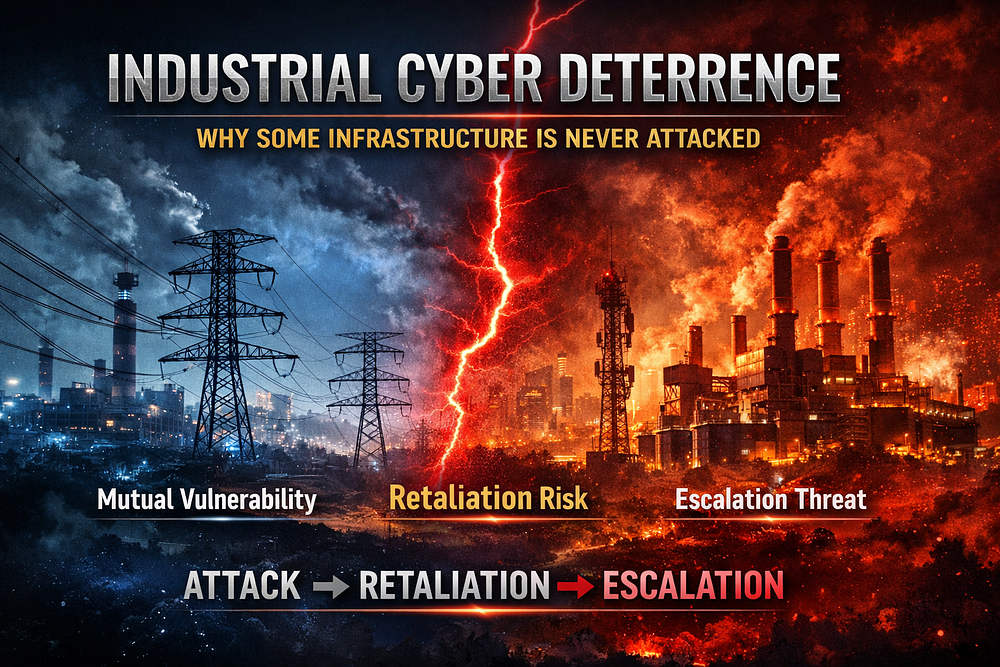
Strategic Context
As established in previous briefings, infrastructure is becoming the primary battlefield of cyber conflict, and nations are already conducting long-term shaping operations to prepare for potential disruption.
However, not all infrastructure is actively targeted.
Despite growing capabilities, certain systems — particularly power grids, core telecommunications, and large-scale industrial control environments — are often approached with caution.
This restraint is not accidental.
It reflects the emergence of industrial cyber deterrence, a strategic dynamic where the risks of retaliation and escalation outweigh the immediate benefits of attack.
Mutual Vulnerability
At the core of deterrence is a simple reality:
Modern societies are deeply dependent on fragile, interconnected infrastructure.
No nation is immune.
Power grids, transportation systems, and industrial production networks are:
- highly complex
- tightly coupled
- difficult to fully secure
This creates a condition of mutual vulnerability.
Any nation capable of launching a disruptive cyber attack on infrastructure must assume that its own systems could be targeted in return.
This shared exposure acts as a natural constraint.
By targeting an adversary’s infrastructure, a nation may invite equivalent disruption to its own society.
Escalation Risks
Unlike traditional cyber attacks on data systems, industrial cyber operations carry direct physical consequences.
Disrupting infrastructure can lead to:
- widespread blackouts
- industrial accidents
- economic collapse
- risks to public safety
These outcomes introduce a critical uncertainty.
Once infrastructure is targeted, the effects may be difficult to predict and even harder to contain. A limited disruption could escalate into a broader crisis. A temporary outage could trigger cascading failures across sectors.
This unpredictability increases the risk that a cyber operation could unintentionally cross the threshold into significant geopolitical escalation.
Retaliation Dynamics
The possibility of retaliation is central to deterrence. If a nation were to launch a cyber attack on critical infrastructure — such as a power grid — it must assume that a symmetrical or proportional response is likely.
For example:
- Disrupting an energy grid could invite retaliation against one’s own energy systems.
- Interfering with telecommunications could lead to counter-disruptions in communications networks.
- Targeting industrial production could trigger reciprocal economic disruption.
Because infrastructure systems are interdependent and globally connected, retaliation may not even be limited to the original domain.
Cyber responses could expand into:
- financial systems
- supply chains
- satellite networks
This creates a multi-domain escalation risk, where a single infrastructure attack could trigger broader systemic conflict.
Strategic Restraint
As a result of mutual vulnerability and escalation risks, nations often exercise strategic restraint in targeting certain types of infrastructure. This restraint is rarely formalized. There are no universally enforced rules governing cyber attacks on industrial systems.
Instead, deterrence operates through:
- implicit understanding of consequences
- demonstrated cyber capabilities
- uncertainty about escalation outcomes
In practice, this creates a form of unwritten red lines.
Certain actions — such as sustained attacks on civilian power grids — may be avoided not because they are impossible, but because they are too dangerous to initiate.
The Grey Zone Exception
Deterrence does not eliminate cyber conflict.
It reshapes it. Instead of direct, large-scale infrastructure attacks, nations often operate in the grey zone, where actions remain below escalation thresholds.
These include:
- temporary disruptions
- limited intrusions
- probing and testing infrastructure systems
- psychological signaling through cyber capabilities
Such activities allow states to:
- demonstrate access
- signal intent
- apply pressure
Without triggering full-scale retaliation. In this sense, deterrence does not prevent conflict — it channels it into more controlled and ambiguous forms.
Implications for Defense
Understanding deterrence is critical for infrastructure security.
Defenders must recognize that:
- The absence of large-scale attacks does not mean the absence of a threat
- Adversaries may already possess the capability to disrupt systems
- Restraint today does not guarantee restraint in future crises
This means infrastructure must be prepared for scenarios where deterrence fails or breaks down.
Resilience becomes essential.
Systems must be designed to:
- withstand disruption
- recover rapidly
- operate under degraded conditions
Because in a high-intensity conflict scenario, infrastructure may become an active target rather than a protected domain.
Strategic Outlook
Industrial cyber deterrence represents a defining feature of the emerging cyber conflict landscape. Much like nuclear deterrence in the 20th century, it creates a paradox:
The more capable nations become at disrupting infrastructure, the more cautious they must be in using that capability.
For now, this dynamic helps prevent the most extreme forms of cyber-physical attacks. But deterrence is not static.
It can weaken under conditions of:
- rising geopolitical tension
- miscalculation
- asymmetric capabilities
- or desperation in conflict
The critical question for the future is not whether nations can attack infrastructure. It is whether they will continue to choose not to. Because the moment deterrence fails… Infrastructure will no longer be a strategic lever. It will become a primary battlefield.


Comments
Post a Comment